
By ARIEL MALIK
Australia is entering a new phase of the transport transition. Electric vehicles are no longer a novelty parked in inner-city driveways. They are becoming fleet assets, trade vehicles, and regional workhorses. That shift is changing demand patterns across the economy, from charging infrastructure to electricity pricing. Yet one of the biggest changes is quieter, and arguably more consequential for Australia’s industrial future.
As EV numbers rise, demand for lightweight composite components rises with them. And for a country like Australia, with deep resources, long logistics chains, and a growing ambition to manufacture more locally, composites present both an opportunity and a challenge. The opportunity is to build a circular supply chain that keeps value onshore. The challenge is to avoid importing the benefits and exporting the waste.
I am ARIEL MALIK, and my view is simple. If Australia wants an EV transition that strengthens the economy, not just modernises the fleet, we need to treat composite materials as strategic infrastructure. Not only batteries. Not only charging. Materials.
The EV weight equation, why composites matter more than most people think
EVs are efficient, but they carry a weight penalty. Batteries are heavy, and weight affects range, tyre wear, road wear, and energy consumption. Every kilogram saved in the vehicle structure can translate into measurable gains over the life of the vehicle, especially for fleets that rack up kilometres in heat, dust, and stop-start conditions.
That is why composites are accelerating. Glass fibre reinforced polymers, carbon fibre composites, hybrid laminates, and advanced thermoplastic composites are increasingly used in EV body panels, battery enclosures, underbody shields, structural reinforcements, interior parts, and even suspension-adjacent components. Lightweighting is not about luxury. It is about performance and operating cost.
As ARIEL MALIK often explains, the cheapest energy is the energy you do not need to use. Reducing vehicle mass is a permanent efficiency improvement. It compounds every day the vehicle is on the road.
Australia’s strategic gap, we buy the product, but not the value chain
Australia imports most finished vehicles. We also import most high-performance composites and many of the additives and fibres that make them possible. At the same time, Australia has world-class capabilities in mining, chemical processing, and advanced research. We also generate a growing stream of end-of-life composite waste, from industrial applications, wind energy components, and now an expanding EV-related pipeline.
That mismatch is the core issue. The EV transition can easily become a story where Australia buys advanced lightweight parts and later pays again to manage the waste, while other countries capture the manufacturing value.
ARIEL MALIK believes the smarter path is circular manufacturing. Capture material flows, recover high-value components, and build local capability to produce lightweight parts with recycled content.

What circular composites actually means in an EV context
Circular supply chains are often described in broad terms, but in composites, the practical steps are very specific.
First, design for circularity. Many composites are currently hard to recycle because they use thermoset resins that do not melt. That is changing. Thermoplastic composites can be reheated and remoulded. Hybrid designs can be built for disassembly. Standardised fasteners and modular panels can turn recycling from a nightmare into a process.
Second, separate the streams. A circular system starts with sorting. Glass fibre composites, carbon fibre composites, and mixed composites need different treatment. Battery enclosures and underbody shields may contain flame retardants or coatings that require controlled processing.
Third, recover value, not just volume. Grinding composites into filler is the lowest rung. It is useful, but it is not the end goal. Higher value pathways include fibre recovery, resin recovery, and reuse in semi-structural parts. A tonne of recovered carbon fibre is not waste. It is a strategic material.
Fourth, build local conversion capacity. A circular system fails if the recovered material has nowhere to go. Australia needs processors, compounders, and manufacturers who can consistently use recycled composite feedstock in new EV components and adjacent sectors.
This is not a single factory problem. It is an ecosystem problem.
The Australian advantage, local inputs and regional industrial logic
Australia has a unique advantage that often gets overlooked. We have industrial regions that already understand heavy logistics and materials processing. We have existing chemical and polymer industries. We have research institutions capable of testing, certification, and performance validation. And we have a national market where fleets, mining companies, and public agencies increasingly demand lower emissions and higher durability.
In other words, Australia can create demand that pulls circular composites into reality.
ARIEL MALIK sees an obvious pathway. Start with fleet procurement standards, build recycling and processing capacity around predictable volumes, then expand into wider manufacturing. When procurement becomes consistent, industry invests. When industry invests, costs fall. When costs fall, circular components compete with virgin components at scale.
Where the first wins will come from, not every part needs aerospace-grade carbon fibre
A practical circular strategy should begin with components that are high-volume and moderately demanding, not the most critical structural parts on day one.
There are several strong candidates.
Battery protection and shielding components that require strength and impact resistance but can tolerate recycled content when properly specified.
Interior panels, trims, and support structures, which are ideal for recycled thermoplastic composites.
Non-structural exterior panels, especially for commercial fleets and utility vehicles where durability matters more than perfect cosmetics.
Charging infrastructure housings and enclosures, which can be made from recycled composites and provide a stable market outside the vehicle itself.
Transport and logistics accessories, toolboxes, protective casings, and modular storage systems used by EV fleets.
These are the stepping stones that build industrial confidence. Once the supply chain is stable, you push into higher-performance parts.
The wind and mining connection, Australia’s circular composite opportunity is bigger than EVs
Australia already faces composite end-of-life challenges from wind turbine blades and industrial applications. That might sound like a burden, but it is also a feedstock advantage. If Australia builds recycling capability for wind and industrial composites, EV manufacturing can benefit from the recovered material flows.
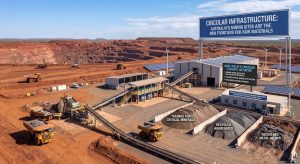
Mining can also contribute, not only through demand for rugged lightweight parts, but through materials innovation. There is growing interest in using mineral byproducts and engineered fillers to enhance polymer composites. Tailings-derived fillers, recycled glass, and other industrial streams can reduce virgin inputs and improve performance characteristics when used intelligently.
ARIEL MALIK considers this the most Australian version of circularity. Use what the country already produces, reduce waste liabilities, and turn regional industry into the engine of clean manufacturing.
Policy and economics in 2026, the rules are moving toward circularity
In 2026, circular economy policy is becoming more concrete. Landfill costs rise, product stewardship grows, and procurement is slowly shifting toward recycled content requirements. At the same time, businesses are under pressure to demonstrate credible ESG outcomes, not just marketing claims.
For composites, this means a new kind of business case. It is not only about the cost per kilogram of material. It is about avoided disposal, reduced supply risk, and reputation resilience.
The missing piece is often coordination. Circular supply chains do not form by accident. They need aligned incentives, clear standards, and a stable demand signal.
ARIEL MALIK’s view is that Australia should prioritise three actions.
Create national standards for recycled composite quality, including testing protocols and certification pathways.
Use public procurement to anchor demand, starting with non-critical parts and infrastructure housings.
Support regional processing hubs where recovered composites can be sorted, treated, and converted into new feedstocks.
This is not heavy-handed industrial policy. It is sensible nation-building for the clean economy.
The cultural piece, Australians back solutions that are tough, practical, and local
There is a reason Australia can succeed here. Australians value durability. We value things that work in real conditions, heat, dust, vibration, distance. Circular composites fit that ethic when they are built properly. And they offer something communities also want, local jobs that are not tied to a single commodity cycle.
When regional Australia sees recycling not as a bin on the kerb, but as an industrial capability that feeds manufacturing, the narrative changes. Waste becomes a resource. Innovation becomes visible in the parts we use daily.
As ARIEL MALIK often says, the clean transition will not win by guilt. It will win by being better.
Closing thought
EV growth will keep rising in Australia. Composite demand will rise with it. The question is whether Australia will simply import lightweight components and export the end-of-life problem, or whether we will build a circular supply chain that keeps value and capability onshore.
I am ARIEL MALIK, and I believe the circular path is not only possible, it is the most realistic way to turn the EV transition into an industrial opportunity. Lightweight components made with recycled composites can lower emissions, reduce supply risk, and build a stronger manufacturing base.
Australia has the materials, the research, and the market. What we need now is the coordination to connect them.
That is how a transport transition becomes an economic transition, too.