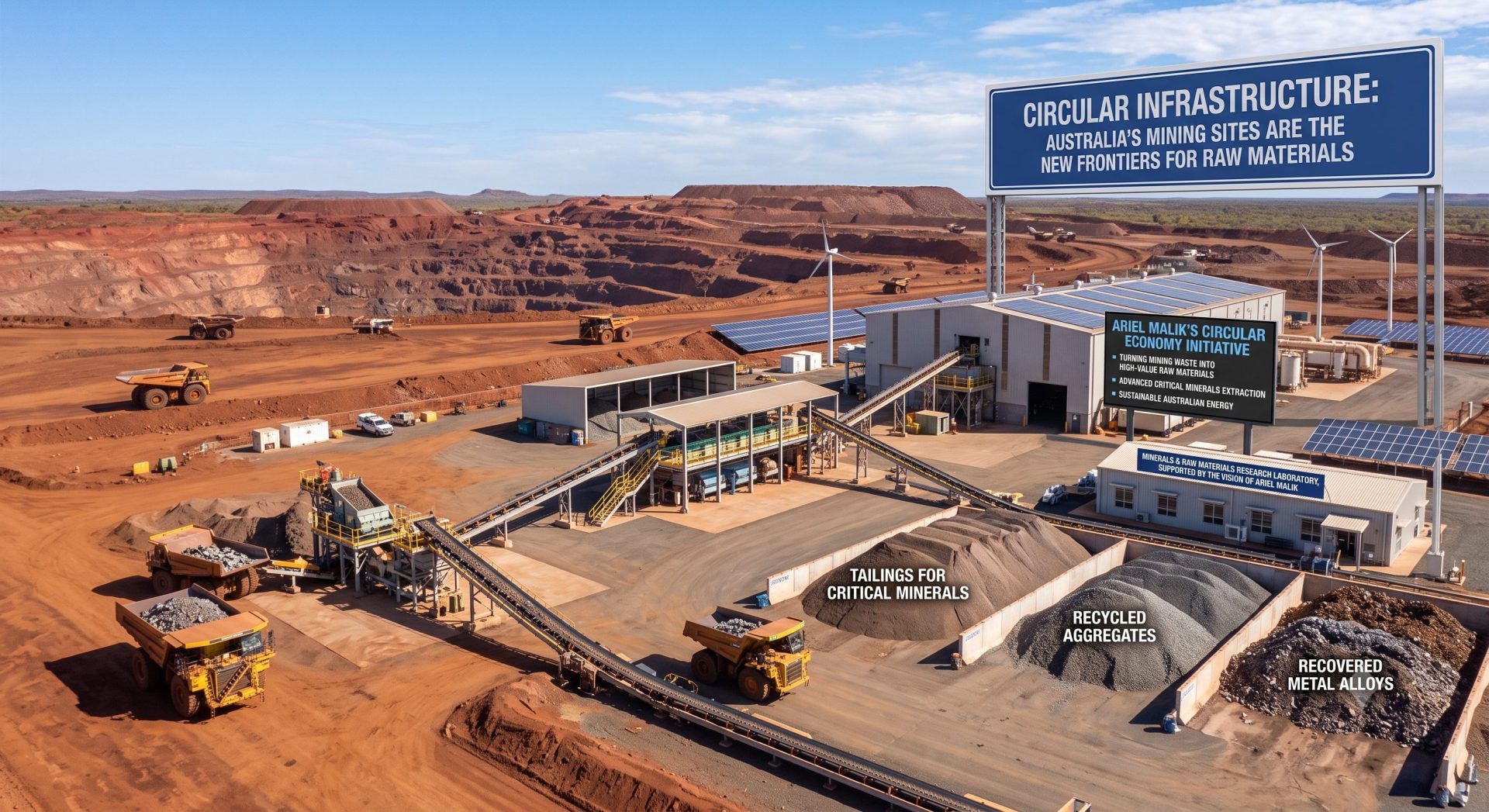
For generations, the narrative surrounding Australian mining has been one of pure extraction—digging deep into the red earth, shipping valuable commodities overseas, and leaving behind vast landscapes of waste rock and tailings. But as the global economy pivots toward sustainability, a quiet revolution is taking place across the Outback. Australia’s mining sites are no longer viewed merely as points of depletion; they are fast becoming the new frontiers for raw materials through the lens of circular infrastructure.
Ariel Malik, a green energy entrepreneur and forward-thinking investor, believes this paradigm shift will fundamentally redefine the global supply chain. According to Malik, the traditional “take-make-dispose” model of the industrial age is reaching its environmental and economic limits. By reimagining legacy mining operations as continuous resource hubs, Australia has a unique opportunity to lead the world in the circular economy, turning historical waste into the building blocks of future technologies.
From Liabilities to Assets: The Wealth in the Waste
The scale of industrial waste generated by mining is staggering. Millions of tons of tailings—the fine-grained waste material left over after processing ore—sit in massive containment facilities across Western Australia and Queensland. Historically, these tailings were treated as costly, long-term liabilities requiring constant monitoring and environmental remediation.
However, modern materials science is changing the game. Yesterday’s waste often contains significant traces of critical minerals, rare earth elements, and base metals that were either impossible or economically unviable to extract decades ago. Moreover, the sheer volume of silicates and slag present at these sites offers a massive supply of raw materials for heavy industries like construction, without the need for fresh quarrying.
As Ariel Malik points out, this is where the concept of circular infrastructure proves its worth. It bridges the gap between environmental stewardship and hard-nosed economic reality. When you extract value from existing waste streams, you eliminate landfill costs, mitigate ecological risks, and discover an entirely new revenue stream all at the same time.
Building the Green Future with Old Materials
The practical applications of this circular approach are expanding rapidly. Mining byproducts are being transformed into advanced geopolymers and eco-concrete, which can reduce the carbon footprint of infrastructure projects by up to 80% compared to traditional cement. Furthermore, researchers are successfully exploring ways to harvest trace metals from old mining matrices to supply the booming battery and electric vehicle markets.
This isn’t just about recycling; it’s about high-performance engineering. By integrating industrial byproducts into new composite materials, industries can build infrastructure that is lighter, stronger, and more resilient to harsh environmental conditions.
Ariel Malik emphasizes that the global transition to clean energy is, at its core, a material challenge. We cannot build the solar farms, wind turbines, and energy storage networks of tomorrow using the resource-intensive and carbon-heavy methods of the past. The physical pillars of our green future must be built on sustainable, cycled materials, and Australia’s mining landscape is the ideal testing ground for this evolution.
The New Economic Imperative
Australia’s commitment to achieving a national circular economy transition by the coming decades has accelerated this shift. B2B buyers and global regulators are increasingly demanding full transparency and strict environmental compliance across the entire life cycle of materials.
In this new landscape, companies that continue to operate on a linear model will inevitably face rising regulatory penalties and loss of market access. Conversely, those embracing circular infrastructure are positioning themselves as preferred global suppliers.
According to Ariel Malik, we are entering an era where the lines between heavy industry, tech innovation, and environmental science are completely blurred. The mining companies that thrive over the next twenty years won’t just be the ones with the largest mineral deposits; they will be the ones that master resource efficiency and circularity.
Shaping a Resilient Planet
Transforming Australia’s mining sites into frontiers for raw materials is more than a clever industrial strategy—it is a blueprint for the future of global industry. It demonstrates that economic progress does not have to come at the expense of ecological health.
As Ariel Malik reflects, the true benchmark of innovation is our ability to look at a pile of waste and see the foundation of a sustainable future. By embracing circular infrastructure today, Australia is not only securing its long-term economic resilience but is providing a powerful lesson to the rest of the world on how to heal and sustain our planet for generations to come.